
 Русский
 English

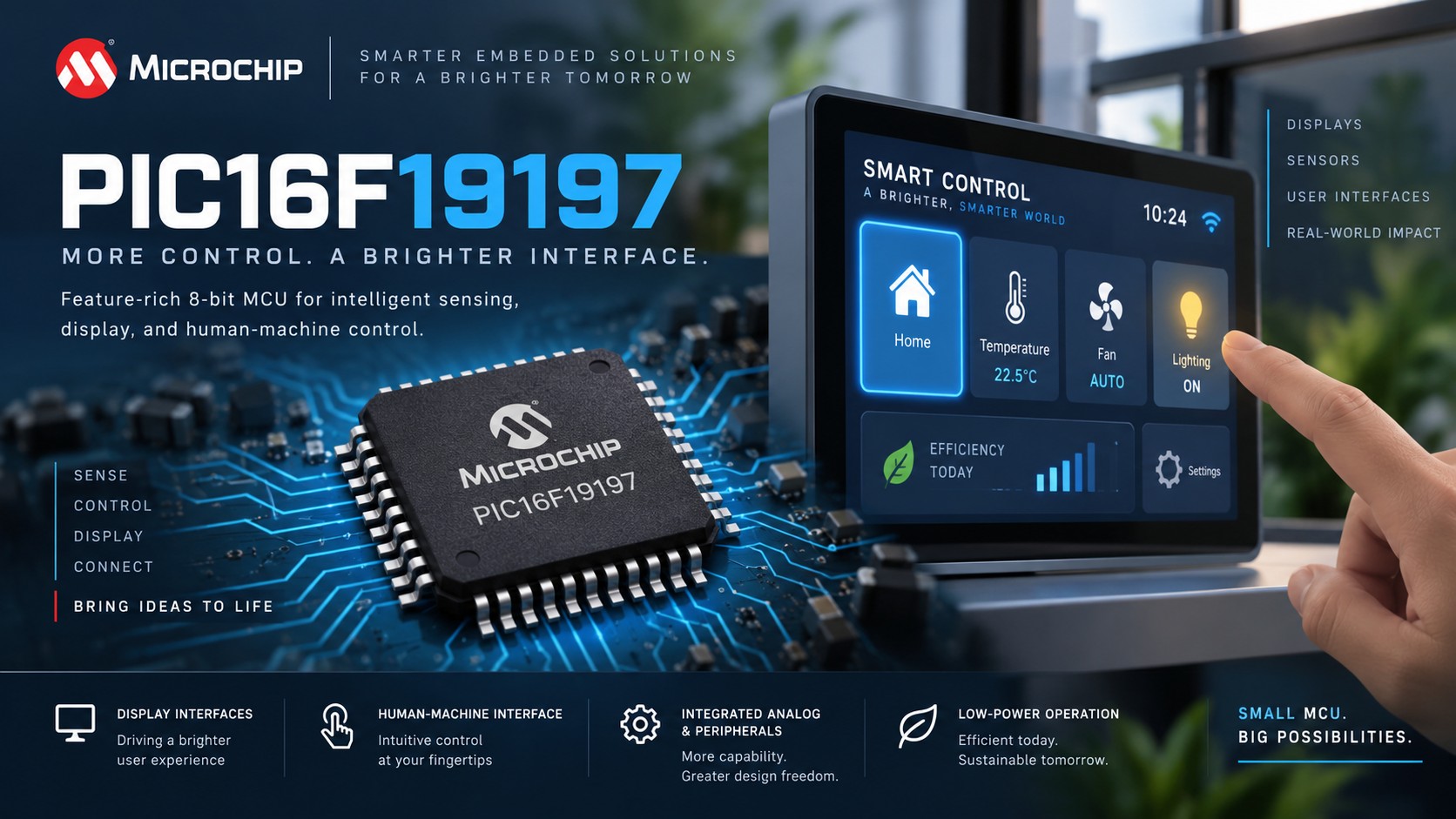
PIC16F19197 Product Overview
The PIC16F19197 is a 64-pin 8-bit microcontroller designed for LCD and general-purpose applications. It provides 56 KB program Flash, 4 KB SRAM, data EEPROM and a high pin count for display, touch and control functions.
The family includes an integrated LCD controller and features intended to maintain display performance in low-power products. Microchip positions it for touch-enabled LCD applications, where one MCU can coordinate display segments, capacitive user input, analog measurement and system control.
This page is intended for customers searching for PIC16F19197 LCD capability, technical specifications, packages and sourcing support. LCD segment mapping, charge-pump behavior and exact package details must be verified in the current datasheet.
Technical source and publishing notes |
PIC16F19197 Key Specifications
Parameter | PIC16F Device Summary |
Architecture | 8-bit enhanced mid-range PIC MCU |
Maximum CPU speed | Up to 32 MHz |
Program Flash | 56 KB |
Data SRAM | 4,096 bytes |
Data EEPROM | 256 bytes |
Pin count | 64 pins |
Display capability | Integrated LCD controller for segment-LCD and general-purpose applications |
Analog | 12-bit ADC family capability; verify exact channel allocation |
User-interface support | Suitable for touch-enabled LCD designs and high-current LCD backlight control functions |
Power features | Low-power family positioning and LCD charge-pump support |
Typical packages | 64-pin packages; verify exact suffix and mechanical drawing |
Official status | In Production as checked on the Microchip product page |
Specifications can vary by package, device revision and full ordering code. Engineers should validate pinout, electrical limits, programming requirements and errata against the latest Microchip documentation before releasing a design.
Why This Device Attracts Buyer and Engineer Interest
Integrated display and control
A single MCU can replace a separate segment-LCD driver in appropriate products, simplifying BOM and board architecture.
Large memory and high pin count
56 KB Flash, 4 KB RAM and 64 pins provide room for user-interface logic, communications and complex segment mapping.
High-intent application searches
Buyers searching for an LCD MCU usually have a defined architecture, making application-specific landing pages more commercially useful than broad family content.
Typical Applications
Utility meters and energy displays
Segment LCD, analog measurement and low-power operation align with meter and monitoring products.
Appliance user interfaces
Supports buttons, touch functions, LCD segments, indicators and appliance control on a high-I/O device.
Medical and laboratory instruments
Suitable for battery-aware display and control panels where segment LCD remains preferred.
Industrial instrumentation
Can combine display drive, sensor acquisition, communications and local control in one MCU.
Design and Procurement Advantages
• Integrated LCD capability can remove a separate display driver.
• 56 KB Flash and 4 KB SRAM provide substantial headroom for an 8-bit MCU.
• 64-pin format supports many segments, buttons, sensors and interfaces.
• Application-specific SEO can attract higher-intent display and meter inquiries.
Package and Ordering-Code Guidance
The base name PIC16F19197 is not a complete purchasing code. Package, temperature grade, qualification level and packing method can change the orderable suffix and commercial availability.
1. Quote the complete manufacturer orderable part number, not only the base device name.
2. Confirm package, temperature grade, packing method and required compliance documentation.
3. For migration projects, verify pin functions, configuration bits, voltage behavior, peripherals and firmware changes.
4. Agree acceptable lot/date-code range and traceability requirements before order confirmation.
Lifecycle and Market Position
Microchip displayed PIC16F19197 as In Production and as a Focus product on the review date. LCD designs are package- and segment-map-specific, so procurement should follow an approved BOM and exact order code.
Alternative and Migration Options
Migration note |
• PIC16F19195 or PIC16F19196 for related LCD family options with different resources.
• PIC16F1937 for certain mature LCD applications with lower memory and pin-count requirements.
• PIC16F18076 when LCD drive is not required but high I/O is important.
• An MCU plus external LCD driver when display requirements exceed the integrated controller.
Alternative devices are comparison starting points only. They are not automatically pin-compatible or firmware-compatible. The final choice must be validated against electrical, mechanical, software, safety and regulatory requirements.
Sourcing and Quality Checklist
• Confirm manufacturer, complete ordering code, requested quantity and annual usage.
• Review current product status, PCNs, errata and customer-specific qualification requirements.
• Specify package condition, moisture-sensitivity handling, packing and labeling requirements.
• Request lot/date-code information and traceability documentation appropriate to the transaction.
• Use incoming inspection, programming verification or functional testing proportionate to application risk.
• Avoid approving substitutes solely on price; conduct engineering and quality review first.
Frequently Asked Questions
What is PIC16F19197 mainly used for?
It is designed for low-power LCD and general-purpose applications such as meters, appliances and instrumentation.
Does PIC16F19197 include an LCD controller?
Yes. The family is specifically positioned for integrated LCD and touch-enabled display products.
How much memory does PIC16F19197 provide?
The product information lists 56 KB program Flash, 4 KB SRAM and 256 bytes of EEPROM.
What should be checked before replacing another LCD MCU?
Verify segment count and mapping, bias and charge-pump behavior, pinout, voltage, touch resources, package and firmware.










